
USA Casinos for UK Players: Licensing and Payments
 Available in GB
The American-casino label does not establish where an operator is licensed or whether it is permitted to serve customers in Britain.

Table of Contents
- What “USA Casino” Means for UK Players
- The UK Legal Position on Playing at an Overseas Casino
- Why a Site That Accepts UK Visitors May Still Be Off-Limits
- Deposits, Withdrawals and the Limits of Payout Promises
- What to Check Behind an “American Casino” Label
- Setting a Deposit Limit Before You Play
- Real-Money Play, Free Spins and Bonus Terms
- Can You Expect Same-Day Withdrawals?
- How to Read Casino Reviews—and Who Stands Behind Them
- Before You Deposit: Real-Money Risks and Safeguards
What “USA Casino” Means for UK Players
“USA casino” is a label, not a regulatory status. On a site aimed at people in Britain, it might refer to an American theme, a connection to the US market, or simply the way the operator describes its games and services. The wording alone does not tell you where the casino is licensed, who regulates it, or whether it holds permission to serve customers in Britain.
That distinction matters because the phrase can make a site sound more specific than it is. “American online casino” and “US online casino” may suggest that the operator is based in the United States or licensed there. “USA-friendly”, by contrast, may be used to suggest that British visitors can use the site. None of these expressions, on its own, confirms either point. A casino’s branding is not a licence, and a reference to the United States does not identify the rules that apply to the operator.
For UK readers, the more useful description is whether the operator holds a licence from the UK Gambling Commission (UKGC). In the context of the British market, a foreign casino is an online gambling operator that accepts British customers without a UKGC licence. Such casinos are licensed offshore and operate outside the UKGC’s regulatory system. The term “foreign” describes the operator’s position in relation to the British licensing framework; it does not mean that the casino is necessarily based in the United States.
If you’re considering a US casino as a player in the UK in 2026, payout timing is one detail to check. Use these verdicts as a brief reference, and verify any other terms that matter to you.
Payout speed: 1-3 business days EvoSpin lists a payout speed of 1–3 business days. If you’re assessing it, treat this as the only confirmed detail here.
Payout speed: 1-3 business days Amunbet lists payouts as taking 1–3 business days. This gives you a stated timeframe to consider when reviewing the operator.
Payout speed: 1-3 business days Jetsetspins gives a payout speed of 1–3 business days. That is the specific detail available for you to weigh.
Payout speed: 1-3 business days Britsino lists a payout speed of 1–3 business days. The available information for your consideration is limited to this timeframe.
Payout speed: 1-3 business days NightWin states that payouts take 1–3 business days. You can use that timeframe as one point to check when evaluating it.
Payout speed: 1-3 business days WinBeast lists payouts as taking 1–3 business days. No other operator details are provided here.
Payout speed: 1-3 business days BeOnBet gives a payout speed of 1–3 business days. This is the confirmed detail available for you to consider.
Payout speed: 1-3 business days SlotoSport lists a payout speed of 1–3 business days. You’ll need to check other details separately if they matter to your choice.
Payout speed: 1-3 business days SpinFormula states a payout timeframe of 1–3 business days. That timeframe is the only specific attribute supplied here.
Payout speed: 1-3 business days x3bet lists payouts as taking 1–3 business days. Use this stated timeframe as a reference when considering the operator.
This is why a search for USA online casinos for UK players can lead to sites with very different identities. One may present itself as American, while another may use the same label without being established or licensed in the US. A third may use “USA-friendly” as a description of whom it says it serves. Those phrases do not establish that the sites share a regulator, licence conditions or status in Britain. The common label can conceal a substantial difference: whether the operator has a UKGC licence at all.
A UKGC licence is a specific authorisation from the British regulator, not a general synonym for being licensed somewhere. An offshore licence does not become a UKGC licence because the casino has a US-themed name, refers to American customers or accepts British visitors. Equally, the word “USA” is not evidence that the operator is licensed by a US authority. The label and the licence answer different questions: the first is part of the casino’s presentation; the second identifies the regulatory framework under which it operates.
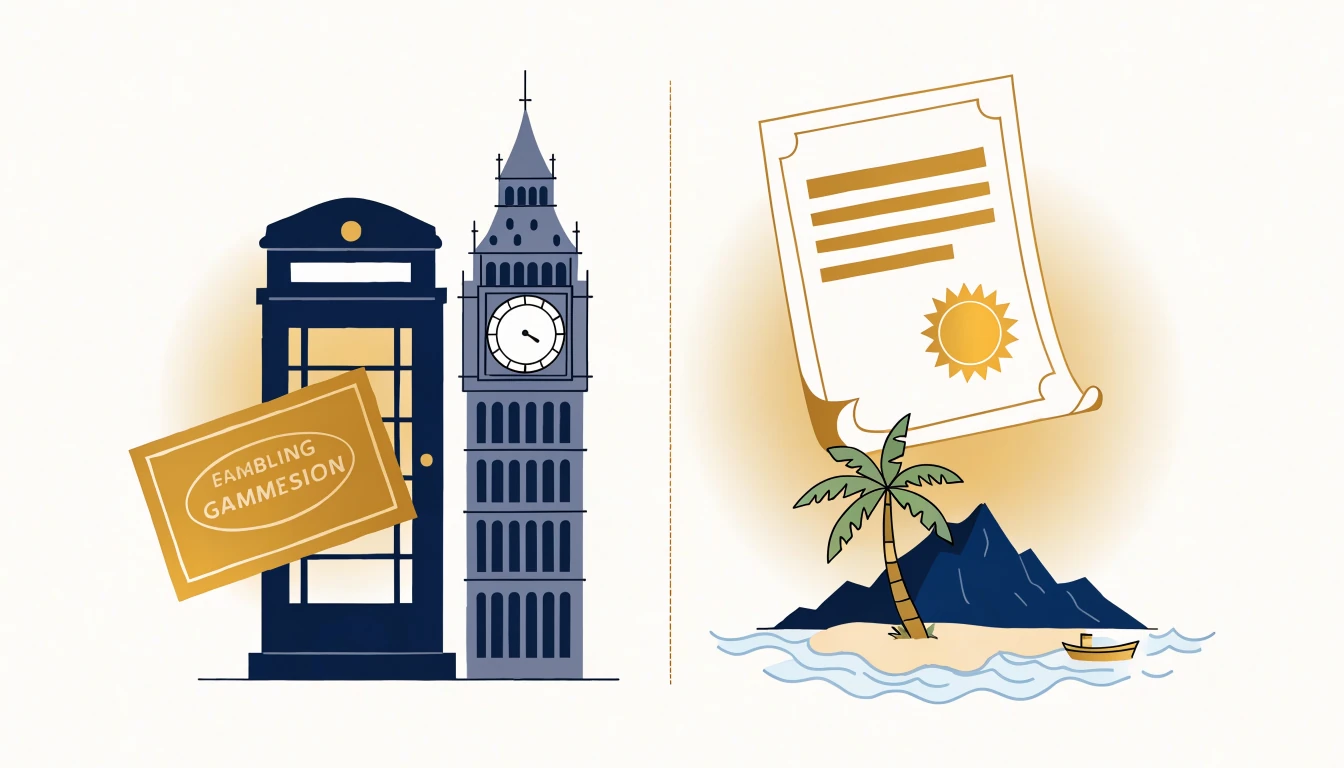
That makes phrases such as “best USA online casino for UK players” difficult to interpret without knowing what “USA” is intended to mean. It could describe the theme, the operator’s claimed location, or its intended audience. “Top” and “new” do not resolve the ambiguity either. A new site may use American branding without that telling you where its licence comes from. A favourable description of a casino cannot turn that branding into proof of UKGC authorisation.
The same applies to an operator that appears to welcome customers from Britain. Its willingness to accept a British customer does not itself establish that it holds the British licence required to operate within the UKGC system. In this article, “foreign casino” is therefore a regulatory description, not a synonym for “American casino”: it means an online gambling operator accepting British customers without a UK Gambling Commission licence. An overseas operator with a UKGC licence would not fit that definition merely because it had links to another country.
It is also worth keeping “licensed” and “regulated in the UK” separate in your mind. An offshore operator may hold a licence outside Britain, but that does not place it under UKGC regulation. Conversely, the word “licensed” without the name of the regulator leaves the relevant jurisdiction unclear. A site can use national imagery or a US-facing description while its licensing arrangements sit elsewhere entirely. The name on the front door is not necessarily the authority behind it.
Attention: A casino’s branding, such as using the word “USA”, is not evidence of its licensing status or authorization to serve the British market.
So when you encounter an American casino label, treat it as a description to interpret, not a conclusion about the operator. It tells you how the site chooses to present itself; it does not establish its location, its licensing jurisdiction or its authorisation to serve the British market. For UK players, the central distinction is whether the operator holds a UKGC licence. “USA casino” and “UKGC-licensed casino” are not interchangeable categories, and one label cannot be used as evidence of the other.
The UK Legal Position on Playing at an Overseas Casino
The legal distinction is between the person placing a bet and the business accepting it. A British player does not commit an offence simply by placing a bet with a casino licensed outside the UK. There is no law in the United Kingdom that makes an individual’s act of betting with an overseas operator illegal, and the player faces no criminal penalty for doing so.
That does not mean an overseas casino is entitled to offer gambling to customers in Great Britain. The operator’s position is different: a business providing remote gambling to people in England, Scotland or Wales must hold the relevant licence from the UK Gambling Commission. Without that licence, offering gambling services to customers there is illegal. The same applies to advertising those services in the UK.
This distinction matters when a site describes itself as an American casino, or as a casino for UK players. The label does not change who is responsible for complying with British gambling law. Nor does the player’s lack of criminal liability make the operator’s activity lawful. A person can place a bet without committing an offence while the business taking that bet is still acting unlawfully by providing gambling facilities to customers in Great Britain without a UKGC licence.

The law addresses operators and players differently
The Gambling Act 2005 governs gambling in England, Scotland and Wales. In this context, it is the operator’s conduct—offering gambling to customers in those countries without the required licence—that creates the legal problem. A UK resident does not become criminally liable merely by accepting an overseas operator’s offer and betting there.
Put plainly, the requirement to hold a Gambling Commission licence applies to the business serving the British market. It is not a rule that makes every bet placed with a foreign casino a criminal act by the customer. The Act does not impose a criminal penalty on a UK resident simply for playing at a foreign casino.
This is a narrow distinction, not a general endorsement of overseas gambling. Saying that a player is not committing an offence does not establish that a site is authorised to serve British customers, or that its activities comply with UK law. The operator’s legal obligations remain its own. A casino’s licence from another country does not replace the UKGC licence required to offer gambling in Great Britain.
What “offering” means in this context
The key legal issue is whether the operator is providing gambling facilities to customers in England, Scotland or Wales. A business based abroad is not exempt from the UK licensing requirement merely because its offices or licence are elsewhere. If it offers remote gambling to customers in Great Britain, it must hold the appropriate Gambling Commission licence.

The same division applies to marketing. An unlicensed operator cannot lawfully advertise its gambling services in the UK. The fact that an advertisement, website or casino brand originates overseas does not turn the operator’s UK-facing activity into a matter that concerns only the player. The legal test described here is about the service being offered to British customers, not simply the country in which the company says it is based.
This is why the question “Can a UK player be prosecuted for placing a bet?” is not the same as “May this casino lawfully offer bets to UK customers?” The answer to the first is that the player is not committing an offence merely by betting with an overseas casino. The answer to the second depends on the operator’s UKGC licensing position: without the required licence, providing gambling facilities to customers in Great Britain is illegal.
Why the distinction is easy to blur
A site may be available to a British customer, and a customer may be able to place a bet, but neither fact settles the operator’s legal status. Equally, the fact that the operator is based outside the UK does not by itself tell you whether it is permitted to serve the British market. The relevant point is whether it holds the licence required to offer gambling in Great Britain.
For readers looking at USA casinos for UK players, the country named in the branding does not alter this framework. A US-facing identity, an overseas address or a foreign licence does not create an exception to the UKGC requirement. But the requirement applies to the operator, not as a criminal prohibition on the individual customer’s act of betting.

Keeping those two positions separate avoids a common misunderstanding: “not illegal for the player” does not mean “legal for the casino to offer”. The law draws a line between the customer’s bet and the operator’s provision of gambling services. For a player, placing a bet with an overseas casino is not itself a criminal offence; for an operator offering gambling to customers in England, Scotland or Wales, doing so without a Gambling Commission licence is illegal.
Why a Site That Accepts UK Visitors May Still Be Off-Limits
A casino website loading on a British connection can look like an invitation. You may be able to browse its games, create an account or reach a payment page. None of those steps shows that the operator is authorised to serve customers in Great Britain, or that it will treat your account as eligible for play and withdrawal.
Access controls and authorisation are separate things. A casino based or licensed outside the UK may be expected to prevent visitors from Britain from using its service. Yet a restriction that exists in the operator’s rules is not necessarily enforced effectively by its website. A report by gambling.com says that some non-UK-licensed casinos do not consistently apply such blocks, and that users may get around them with a basic VPN. That is a report about access, not evidence that a particular site accepts UK customers on its terms or is permitted to do so.
Payout Risks
Unlicensed sites may refuse to pay winnings, leaving customers without legal recourse or UKGC oversight.
A VPN can also make a visitor appear to be connecting from somewhere other than their actual location. That does not change the operator’s licence, its terms or the protections available to a customer in Britain. Nor does it settle whether the site will accept an account, allow a deposit or later approve a withdrawal. Technical access is a narrow fact: the page can be reached. It is not a promise about what happens after you use it.
This distinction matters when people look for US casinos accepting UK players. “American” can describe a brand’s image or a site’s claimed location, but it does not tell you whether the operator has permission to serve the British market. A site may appear to welcome UK visitors while its own rules exclude them, or may allow the early stages of account use without resolving whether the customer is eligible. An open registration form is not a regulator’s approval.
There is also a difference between a site that merely displays content and one that actually accepts a customer’s gambling activity. A homepage can be accessible even when account conditions restrict play from Britain. Conversely, a site may fail to block a visitor at the point of entry without changing the regulatory position. If a site’s access controls are weak, the practical result can be confusing: the interface may allow a step that the operator’s rules or licensing position do not support.

For a player, that uncertainty can become most serious when money is involved. A withdrawal is not assured just because a deposit was accepted or the account appeared to function. The operator may later rely on its terms or eligibility checks when deciding whether to process a payout. This is not a claim that every overseas site will refuse a withdrawal; it is a reason not to treat successful access as proof that the relationship is secure.
The risk is not merely theoretical. gambling.com has reported cases in which unlicensed sites refused to pay customers’ winnings, leaving those customers without legal recourse. That report should not be turned into a claim about every foreign casino, but it shows why a working website and a displayed balance are not the same as a dependable route to a payout. If a dispute arises with an operator outside the UK Gambling Commission’s system, you do not have UKGC oversight of that operator.
This limitation applies even if the site has a licence somewhere else. An overseas licence is not a UKGC licence, and an operator outside the Commission’s remit is not regulated by the UKGC. It does not provide UKGC protection or UKGC-mandated affordability checks. A polished site, a familiar payment page or a message saying that British visitors are welcome cannot substitute for those protections.

The question “Do USA casinos accept UK players?” therefore has no reliable answer based only on whether a page opens. One operator may block British visitors; another may not enforce its restriction consistently; a third may let a visitor proceed while retaining terms that create problems later. The important distinction is between being able to get in and having clear, enforceable standing as a customer. Those are not interchangeable.
If a site appears available, treat that appearance as a technical signal, not a confirmation of authorisation or payout rights. A casino’s willingness to let you register does not establish that it is entitled to offer gambling to customers in Britain, and it does not bring the account within UKGC oversight. For anyone comparing American-branded casino sites, that is the inconvenient point: access can be easy while the protections and certainty a UK player might assume are absent.
Deposits, Withdrawals and the Limits of Payout Promises
A withdrawal estimate is not necessarily the time it takes for money to reach you. It may describe only the operator’s processing stage, or it may include the payment provider’s transfer time. If a casino holds a request for review before sending it, that delay comes before the payment route can do its part.
The route matters. E-wallets such as Skrill and Neteller are reported as the fastest option at many foreign casinos: most process these withdrawals within 24 hours, and many do so in under 12 hours. That is a reported pattern, not a guarantee for a particular casino or transaction. Check whether the stated time starts when you submit the request or after the operator approves it.

Bank transfers tend to take longer. A specialist casino review reports that they can take five to seven business days, with some foreign operators adding an internal processing delay before the bank transfer begins. Business days matter: a weekend or bank holiday can extend the wait even when the casino has released the funds. A headline estimate that does not explain whether it includes the operator’s own queue is incomplete.
Crypto can be quicker, but speed is only one part of the calculation. A specialist review reports that crypto withdrawals at foreign casinos can clear in under an hour. The value of the cryptocurrency can change, however, so the amount received may not retain the same value as when the withdrawal was requested. A quick transfer is not the same as a predictable cash value.
The process also depends on the casino’s rules. Withdrawal limits, pending periods and verification procedures vary considerably between operators, according to specialist reviews. A pending period means a request remains unprocessed for a time before it is sent; verification may also hold up a payment while details are checked. Read the withdrawal terms, not just the payment-method summary, and look for any conditions that could affect the amount or timing of a cash-out.
That distinction is especially important when comparing USA casinos for UK players. A site’s advertised payout speed does not establish how quickly it will approve your request, and a fast payment option cannot remove an operator’s own checks or delays. The practical timeline is the combination of the casino’s handling time and the payment route—not the most attractive number in a banner.
Offshore casinos are not regulated by the UK Gambling Commission and do not provide UKGC-mandated affordability checks.
These casinos are offshore and are not regulated by the UK Gambling Commission. They therefore do not provide UKGC-mandated affordability checks. A payout promise should not be treated as evidence of UK oversight or as assurance that a dispute will be handled under UKGC rules. Before depositing, consider whether you are comfortable with the operator’s stated procedure and with the possibility that the final transfer may take longer than the headline suggests.
What to Check Behind an “American Casino” Label
“American” can describe a theme, a brand or the way a site presents itself. It does not, by itself, tell you which company operates the casino, where that company is licensed, or what rules apply to it. A site aimed at British visitors may use American imagery without being licensed in the United States. The label is not a regulatory status.
Start with the operator’s identity. Look for the legal company name in the site’s terms and conditions, then compare it with the name given in the licensing information. If the operator is hard to identify, or the details do not match across those pages, the branding cannot resolve that uncertainty. A recognisable name or polished presentation is not a substitute for knowing who is responsible for the service.
Next, read what the licence information actually says. A licence issued outside Britain is not a UK Gambling Commission licence. Offshore casinos are not regulated by the UKGC, even if they describe themselves as licensed or regulated elsewhere. That distinction matters: an overseas licence does not bring a casino within the UKGC’s regulatory system or make its standards equivalent to those that apply to a UKGC-licensed operator.

This also means that an offshore casino does not provide UKGC-mandated affordability checks. Do not infer that those checks apply because a site accepts customers in Britain, uses familiar payment branding, or has terms written for an English-speaking audience. The relevant question is which operator holds which licence—not how the casino describes its market.
If a site advertises itself as a “USA casino”, treat the phrase as a clue to investigate, not as proof of American regulation. Check whether its own legal information names a regulator and an operating company, and whether those details are specific enough to identify the arrangement. A badge or a claim on a promotional page is less informative than the underlying terms and licensing statement. If the information is unclear or contradictory, you have no sound basis for assuming which standards govern the operator.
The same caution applies to reviews. A favourable assessment of American casino sites for UK players does not establish that the operator is authorised by the UKGC. Read any review for concrete information about the company and its licence, rather than relying on labels such as “trusted”, “safe” or “best”. Those words are conclusions; they do not identify the regulator or explain the limits of its authority.
Claims about “no verification” deserve particular care. A promotional phrase cannot tell you, on its own, what the operator may require or what happens when you use the service. Likewise, a “no wagering” bonus claim says nothing about the casino’s licensing position. Keep those claims separate from the question of who operates the site and which regulator, if any, oversees it.
Verify Operator Status
- Identify the legal company name in the terms and conditions
- Compare the company name with the licensing information
- Establish if the licence is issued by the UK Gambling Commission
- Check if the regulator and operating company are specifically named
The useful check is therefore a plain one: identify the operator, locate its licensing details, and establish whether the licence is from the UK Gambling Commission. If it is offshore, it is outside UKGC regulation; an American label does not change that.
Setting a Deposit Limit Before You Play
A deposit limit sets a ceiling on how much you can pay into a gambling account over a chosen period. It is a budgeting control, not a promise that you will stop gambling once you reach it, and it does not tell you what the casino’s minimum deposit is. If you are comparing low-deposit offers, keep those two figures separate: one concerns the amount needed to make a deposit; the other is a cap you set for yourself.
At a UKGC-licensed operator, a deposit limit takes effect immediately. You must be able to lower it straight away, while an increase is subject to a 24-hour cooling-off period. That delay gives you time to reconsider a decision to raise the amount you can deposit. A lower limit can therefore apply to your next deposit rather than waiting for a later review.
Do not assume those rules apply to a site simply because it accepts a deposit from Britain or uses an American label. Offshore casinos are not regulated by the UK Gambling Commission, so UKGC requirements do not govern their accounts. They also do not offer UKGC-mandated affordability checks. Read the operator’s own terms to find out whether it provides deposit limits and how changes work; the existence of a control on one site does not establish that another has the same process.
When choosing how much to set, consider what you can afford to lose, rather than treating the limit as a target to spend. A limit can make deposits more deliberate, but it cannot guarantee that gambling stays within your wider budget if you use other accounts or payment routes. If you have self-excluded through GamStop, a foreign casino is outside that scheme; a deposit limit is not a substitute for self-exclusion.
The practical test is whether the limit is clear, easy to set and hard to raise impulsively. Before depositing, check where the limit applies, when a reduction takes effect and what happens if you request an increase. For UKGC-licensed accounts, the reduction is immediate and an increase has the cooling-off period described above. For an offshore account, do not rely on that timetable unless its own terms confirm it.
Real-Money Play, Free Spins and Bonus Terms
Offers at casinos outside the UK may be presented as welcome packages, but the headline value does not tell you how much of it can be withdrawn. A specialist review describes foreign casinos as offering larger welcome packages, attributing this to their not being bound by UKGC restrictions on bonus terms, wagering requirements and promotional language. That is a reported explanation, not a guarantee that any particular offer is generous or worthwhile.
A specialist review identifies deposit matches, free-spins packages, no-deposit bonuses and cashback offers among the formats found at foreign casinos serving UK players. A deposit match adds bonus funds in relation to a deposit; free spins are spins offered for specified games. A no-deposit offer does not require a deposit to claim, while cashback returns some amount under the offer’s terms. None of these labels, by itself, tells you whether the resulting funds can be withdrawn.
The key term to look for is the wagering requirement. This sets how much you must stake in qualifying bets before bonus funds become eligible for withdrawal. The requirement can apply to the bonus, the deposit, or both, so read the wording rather than assuming the advertised amount is cash you can take out.
A specialist review illustrates the calculation with a £20 bonus carrying a 35x wagering requirement: the player would need to place £700 in qualifying bets before cashing out. Another review example describes a 100% match bonus of £100 with a 35x requirement, which would mean £3,500 in bets before the bonus funds become withdrawable. These are illustrations of how the arithmetic works, not standard terms for every casino.
For an offer involving free spins, check whether any winnings are treated as bonus funds and whether they carry their own wagering conditions. Also look for which games and bets count towards completion, and whether the terms set restrictions on using the bonus. The details can change what an offer is worth in practice.
If you are considering real-money play at a foreign site, do not treat a large bonus or a free-spins headline as evidence of value or protection. Offshore casinos are not regulated by the UK Gambling Commission and do not provide UKGC-mandated affordability checks.
Can You Expect Same-Day Withdrawals?
An “instant withdrawal” label does not mean that money will reach your account as soon as you request it. A casino may need to review and approve the withdrawal before the payment provider or bank starts its part of the process. The time shown in an offer or on a payment page may therefore describe only one stage.

E-wallets are the fastest withdrawal option on the UK market: most operators process them within 24 hours. That is a processing timeframe, not a promise that every withdrawal will arrive the same day. Delays can arise before a payment is released, and the operator’s own rules matter as well as the payment method.
Bank transfers take longer. A specialist review reports that they often require five to seven business days, with some foreign casinos adding an internal processing delay before the transfer reaches the banking stage. Weekends and the operator’s handling can make a same-day expectation particularly unrealistic for this route.
The details are not consistent across casinos. Withdrawal limits, pending periods and identity checks differ between operators, so a timing claim should be read alongside the terms for the specific payment method. “Pending” means the casino has not yet released the request; the payment provider’s transfer time comes after that. A headline estimate that leaves out this distinction can give a misleading impression.
This matters especially when considering a USA-labelled casino serving British visitors. The label does not establish a common payout procedure, and offshore casinos are not regulated by the UK Gambling Commission. Their timelines are not backed by UKGC oversight, and they do not provide UKGC-mandated affordability checks. A claim of same-day payment is not, by itself, evidence of when funds will be available to you.
Before depositing, look for the stated processing period, any pending stage and the conditions that could require verification. Treat “instant” as a description to test against those terms, not as a dependable arrival time.
How to Read Casino Reviews—and Who Stands Behind Them
A favourable casino review is a verdict, not proof that a site is safe or suitable. To judge its weight, look for clear explanations of how the reviewer assessed the operator and whether the review discloses commercial relationships. A page that lists benefits but says little about who funds it gives you less reason to treat its conclusions as independent.
Commercial ties do not automatically make a review false. They do change the context in which you should read it. Check whether the publication earns money when readers visit or sign up, whether it distinguishes reporting from promotion, and whether it explains material facts that might put a casino in a less flattering light. A confident tone is not a substitute for those details.
The Santeda–SIS relationship shows why that context matters. Santeda’s Curaçao licence did not authorise it to operate in the UK or the US. Under a contract with Santeda, SIS received a share of revenue generated by losing bets placed through Santeda’s brands. That does not, by itself, establish what any particular review said or whether it was influenced. It does show why a reader should ask who has a financial connection to a gambling business, and what that connection involves.
Treat review language as a starting point for checking claims, not as an assurance. A reviewer’s positive assessment cannot establish that an operator has the protections or accountability of a UK-regulated casino. Look for the basis of the verdict, the interests disclosed, and the distinction between verifiable information and opinion. If those are unclear, the review’s confidence should carry little weight.
Before You Deposit: Real-Money Risks and Safeguards
A site accepting real-money deposits from UK players may still sit outside the protections attached to a UK Gambling Commission licence. Offshore casinos are not regulated by the UKGC, and they do not provide UKGC-mandated affordability checks. Their procedures and safeguards should not be assumed to match those of a UK-licensed operator.
GamStop is one important difference. It covers every UKGC-licensed operator, so registering for self-exclusion blocks access to all UK-licensed gambling sites. Foreign casinos outside the UKGC’s remit are not covered by GamStop. If you have self-excluded, that separation matters: an account at an overseas site may not be blocked by the scheme.
The absence of UKGC oversight also means you should not treat a casino’s own assurances as equivalent to regulatory protection. A claim that a site accepts UK customers, or that it can pay real money, does not establish that UK safeguards apply. Consider the limits of the protections available before depositing, particularly if you rely on self-exclusion or affordability measures to manage gambling.
Tax treatment is separate from licensing. Gambling winnings are not subject to UK income tax, whether they come from a UKGC-licensed operator or an overseas one. That does not make the operator regulated in Britain, or supply safeguards that are absent.
The label “USA casino” does not alter these points. If you are considering a site described that way, distinguish its payment claims from the protections it actually falls under. A real-money balance and a UK safety net are not the same thing.
Is playing at an international casino legal for UK residents?
Yes. You do not commit an offence by betting with a casino licensed outside the UK, although an operator offering gambling to customers in England, Scotland or Wales without a UK Gambling Commission licence is acting illegally.
Is it legal for UK residents to use casino sites that operate outside the UK’s licensing framework?
Yes, using such a site is not a criminal offence for you. However, an operator without a UKGC licence is not legally allowed to offer gambling services to customers in England, Scotland or Wales.
Are gambling winnings subject to income tax in the United Kingdom?
No. Gambling winnings are not subject to UK income tax, whether the casino is UKGC-licensed or not.
Are bonuses at foreign casinos actually better than at UKGC-licensed sites?
Foreign casinos often offer larger welcome packages because they are not bound by UKGC restrictions on bonus terms and promotions. Check the wagering requirement: for example, a 35x requirement on a £100 bonus means £3,500 in qualifying bets before the bonus can become withdrawable.
What should I do if a casino refuses to pay my winnings?
If the casino is unlicensed in the UK, you may have no legal recourse if it refuses to pay. Check the operator’s licence and regulator before depositing.
How long do withdrawals take at the listed operators?
It depends on the payment method and the operator’s processing rules. E-wallets such as Skrill and Neteller often clear within 24 hours, crypto withdrawals can take under an hour, and bank transfers commonly take five to seven business days; verification, pending periods and limits also vary.
Published by the Rainbow Riches Casino 5 team.